
LOT · From the team
Acun Kaya presents LOT’s vision in Palo Alto
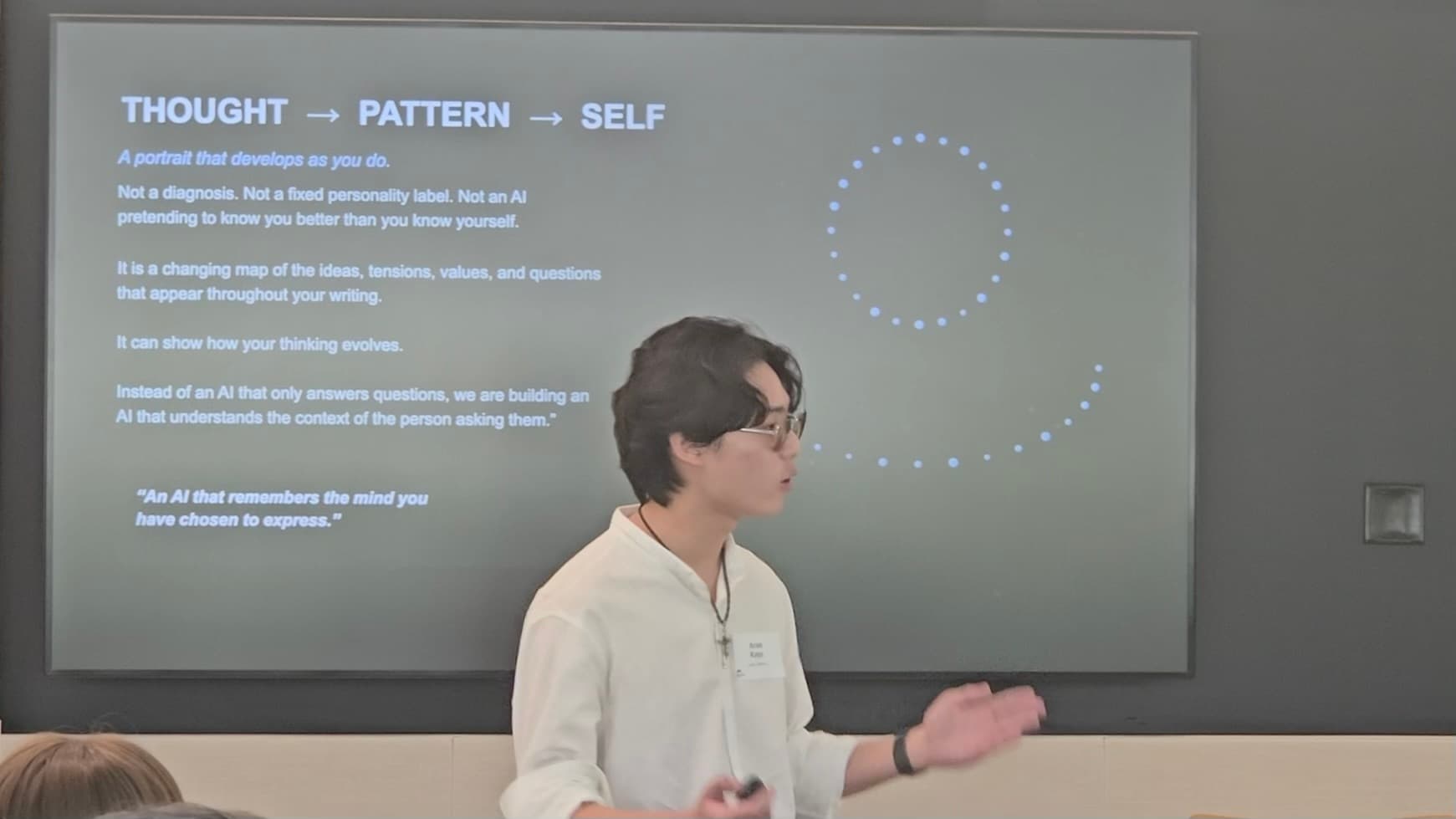
Palo Alto, California — Acun Kaya, CEO of Super Able Inc., Product Architect of LOT, and head of the LOT Team, presented the thinking behind LOT to investors in Palo Alto: a private space for recording your inner life, an intelligence that helps you reflect on it, and a way to connect with people through meaningful understanding.
The presentation centered on a question that guides our work: how can technology help people make sense of the thoughts they live with, including the ones they struggle to put into words?
Why we call it LOT
Kaya introduced the product’s name through the Language of Thought hypothesis associated with Jerry Fodor. For our team, that idea is an inspiration for a product question: what happens to the parts of our experience that never become a finished sentence, a message, or something we feel ready to share?
A feeling can arrive before we know what to call it. A question can return for years before we recognize the pattern. We may forget the details of an experience while still finding it meaningful later.
LOT begins with the traces people choose to record. The ambition is to help those fragments become easier to revisit and understand. It is not a claim that an app can capture every thought or know the whole of a person.
A private place to build understanding over time
The first part of the vision is a personal space for thoughts, feelings, and experiences. Writing does not have to be polished or intended for an audience. A few words about an ordinary day can matter as much as a longer reflection.
Kaya described how, with a person’s permission, intelligence could help connect those records across time. Recurring questions, changes in perspective, and relationships between experiences could form a developing cognitive portrait: a way to explore your writing rather than reduce you to a fixed personality label.
The long-term possibility is a more useful relationship with your own history. Returning to an old thought might help you notice what has changed, what you still care about, or why a familiar question has come back. Those connections would remain interpretations to examine, not psychological conclusions to accept.
Personal context, not just another answer
The presentation also explored the difference between answering an isolated question and helping someone reflect with context they have chosen to provide.
Our focus is the latter. A useful companion should be able to draw on relevant writing, recognize the limits of what it knows, and let the person correct its understanding. Its value should develop through the person’s own words and choices.
This is a product direction, not a claim that LOT understands someone completely or can recover forgotten memories. We see it as support for reflection, not a substitute for professional care or human relationships.
Connection through shared understanding
The second part of the vision moves from private reflection to optional connection. Kaya discussed a social experience built around related thoughts and situations, where the starting point is something people recognize in each other’s experience.
A public reaction can acknowledge a post without opening a deeper conversation. We are interested in what makes that next step possible: a shared question, a similar tension, or the feeling that another person understands what you are trying to say.
Any path from private writing to social participation needs a clear choice. Sharing and introductions should be voluntary, and similarity should be treated as a possible beginning for a conversation, never a guarantee of compatibility or understanding.
From the presentation to the work ahead
The investor discussion brought the vision back to practical questions: whether people would return to the product, how personalized intelligence could be delivered sustainably, and what would make the experience worth paying for.
For our team, the next work is to test those questions through a useful product. That means improving the quality of reflection, making connections to past writing understandable, explaining privacy choices clearly, and learning which experiences help people enough that they choose to return.
The presentation described a long-term direction, not a promise that every idea is already available. We will develop and evaluate these experiences step by step.
Our vision for LOT is a place where thoughts can stay private, become a source of self-understanding, and, when you choose, open a conversation with someone else.
Learn more about LOT — Language of Thoughts.